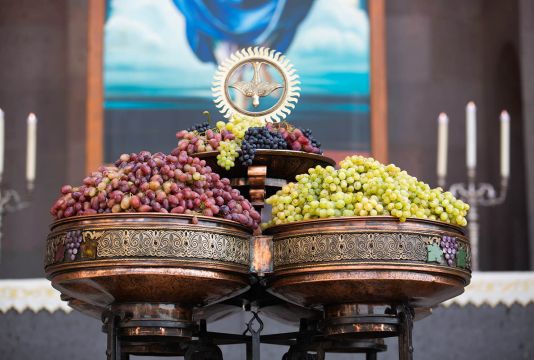
The Feast of the Assumption of the Holy Mother of God is one of the five major feasts of the Armenian Church. It is celebrated on the Sunday closest to August 15, between August 12 and 18.
According to tradition (as recorded in the Protoevangelium of James and the apocryphal Gospel of John), after the Holy Virgin died, the apostles buried Her body in a tomb dug in the Garden of Gethsemane. The Apostle Bartholomew was not present at the burial. Several days later, when he went to the tomb with the other apostles to bid farewell to the Holy Virgin, they opened the tomb but did not find Her body there; only the fragrant burial cloth remained.
Based on this tradition, the Fathers of the Church established the Feast of the Assumption of the Holy Mother of God, affirming that Her body was taken up to Heaven.
The feast was first celebrated in Jerusalem at the beginning of the fifth century. The center of the celebration was a church dedicated to the Mother of God, located at the third milestone on the road from Jerusalem to Bethlehem. At that time, the celebration took place on August 13. Later, the place of celebration was moved to Gethsemane, where the tomb of the Holy Mother of God was located, and the date of the feast was set as August 15.
In the sixth century, the feast spread to Syria. At the end of the same century, Emperor Maurice made it obligatory throughout the Byzantine Empire. During this period, the feast was also known in Armenia. At the beginning of the seventh century, the feast began to be celebrated in the West as well.