Before His Ascension, Christ commanded the Apostles to preach the divine doctrine throughout the whole world and to baptize all nations in the name of the Father, and of the Son, and of the Holy Spirit (Matt. 28:19-20).
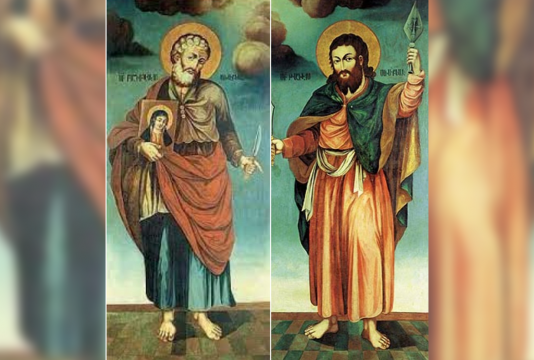
Among Christ’s Twelve Apostles, Saints Thaddeus and Bartholomew carried the Gospel to Armenia, spreading the light of Christianity across its lands.
Saint Thaddeus first preached in Palestine and Assyria (Syria), and afterwards in Caesarea of Cappadocia, where he ordained Theophilus as bishop.
From there, he went to Edessa and, together with Thaddeus, one of the Seventy-two Disciples of Christ, continued preaching the Gospel in northern Mesopotamia, within the domains of Armenian King Abgar V.
By the letter of King Abgar, who had fervently believed in Christ, the Apostle Thaddeus set out to his nephew Sanatruk, appointed governor and commander of the army over the lands of Greater Armenia.
The Apostle then proceeded to the province of Artaz in Vaspurakan (formerly Shavarshan), where Sanatruk’s summer residence stood. After the death of King Abgar, Sanatruk proclaimed himself king.
While preaching in Artaz, Saint Thaddeus gathered many followers, among them Prince Samuel—so named after his baptism—and Lady Zarmandukht, a noblewoman of the royal household.
Princess Sandukht, still a young maiden, also became a disciple of the Apostle; fervently devoted to Christ, she was baptized by his own hand. By order of King Sanatruk, she and other Christians were put to death, thus receiving the crown of martyrdom.
By the king’s command, the Apostle Thaddeus was condemned to a cruel fate. First, he was cast before two lions, yet the beasts bowed before him and licked his feet. He was then thrown into a fiery furnace, but a sudden, cool wind mingled with the morning dew arose, leaving the Apostle unharmed while the flames turned upon the gathered spectators. Through these and other miracles, many were brought to believe in Christ.
The Apostle Thaddeus prayed that God would preserve the newly converted community and cause the seeds of Christianity to flourish in Armenia.
As they led him to be slain by the sword, the executioner struck his own brother, Zementos, a compassionate man and overseer of the roads. Grieved by this, the Apostle prayed to Christ, and Zementos was restored to life. Falling at the Apostle’s feet, the resurrected Zemendos declared, “I confess the God whom you proclaim.” This miracle brought many more to conversion.
The Apostle appointed the newly restored Zementos as shepherd of the faithful and ordained his disciple Zakaria as bishop of Artaz. Yet despite these wonders, King Sanatruk remained spiritually blind and merciless. By his order, the Apostle Thaddeus was executed by the sword. When the faithful sought to bury the martyr on a nearby height, a heavenly light shone forth, a great earthquake struck, and the rock opened to receive the body of Saint Thaddeus.
After preaching throughout the Parthian kingdom, Saint Bartholomew entered Armenia accompanied by eight disciples. He ministered in the Goghtn province of Syunik, where Prince Shar (Shara), his wife Nshna, their son Khosrov, and grandson Vahan embraced Christianity and supported the Apostle.
In the village of Ordvat, the Apostle built the Church of the Presentation of the Lord and appointed his disciple Kumsi as bishop to shepherd the new community. Upon Kumsi's passing, another disciple, Babelas, succeeded him.
From Goghtn, Saint Bartholomew traveled to the Her and Zarevand provinces in Persian Armenia (Parskahayk), preaching and fortifying the faithful. He then arrived in Great Aghbak of Vaspurakan, where his words moved Queen Vogouhi, sister of King Sanatruk, to follow Christ.
To turn her from the faith, Sanatruk sent his commander Terentius. Yet, hearing the Apostle speak of the Savior and the hope of salvation, Terentius himself was converted. Suffering from leprosy, he was healed when baptized, as a cloud descended above them and his diseased skin fell away like a shell, and he was healed.
Remaining steadfast in the faith, both Vogouhi and Terentius were martyred by the sword on the king’s command, receiving the crown of martyrdom.
In 66 AD, Saint Bartholomew himself was martyred in Aghbak: first beaten to exhaustion, then flayed.
Through the preaching of Saints Thaddeus and Bartholomew and the establishment of episcopal sees in Artaz and Goghtn, the Armenian Church was founded, officially known as the Armenian Apostolic Orthodox Holy Church.
The Apostle Thaddeus brought to Armenia the Holy Geghard, the sacred Lance with which Christ was pierced, along with the Lord’s blessed oil, which, continually mixed with the Holy Myron, is passed down through generations.
The Apostle Bartholomew brought an icon of the Holy Mother of God, which he placed in Darbnats Kar of the Andzevatsyats province in Vaspurakan, founding the convent of Hogyiats Vank. South of the Araxes, in Magharta, he established a church, laying three manna-stones in its foundation—this became the Monastery of Saint Stephanos of Magharta.
Over the tombs of the holy Apostles, churches and monasteries were built:
The Monastery of Saint Thaddeus in Artaz (now in Iran)
The Monastery of Saint Bartholomew in Aghbak (now in Turkey)
For centuries, these remained revered pilgrimage sites.