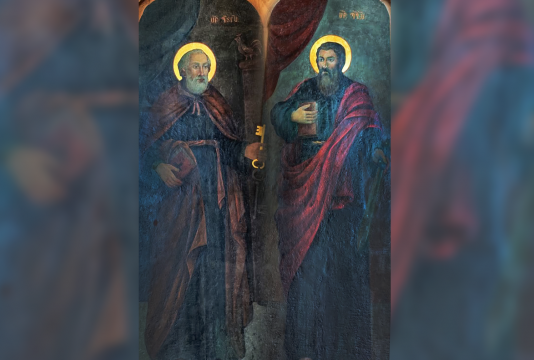
Saint Peter the Apostle († 67 AD) was the chief among the Apostles. He had been a fisherman. When Jesus first met Peter, He said to him: “Thou art Simon the son of Jona: thou shalt be called Cephas” (John 1:42). Cephas means “rock” in Greek (Petros). By a divine vision, Saint Peter was instructed by God to baptize and receive even the Gentiles into the bosom of the Church (Acts 10).
Saint Peter preached in Palestine, Phoenicia, and Syria—especially in Antioch—in many cities of Asia Minor, in Macedonia, and in Sicily. From there, he traveled to Rome, the imperial capital. There, under Emperor Nero, in 67 AD, he was martyred by being crucified upside down. Later, the Basilica of Saint Peter in Rome was built over his burial site.
The two catholic epistles of Saint Peter the Apostle are included in the New Testament.
Saint Paul the Apostle († 67 AD) is known as the Thirteenth Apostle and the Apostle of the Gentiles. The account of Saint Paul’s conversion to Christianity is recorded in Acts 9:1–40, and his apostolic activity and martyrdom are described in chapters 14–28.
Thanks to the steadfastness of Saint Paul, in 49 AD, the newly established Church addressed the question concerning converts who were not of the Jewish faith, and it was decreed that they be released from the obligations and requirements of the Jewish Law.
Saint Paul preached in Syria, especially in Antioch, in many cities of Asia Minor, in Greece, on Cyprus, and in Rome, where he had been brought as a prisoner. In Rome, he suffered martyrdom during the persecutions of Emperor Nero in 67 AD.
The fourteen epistles of Saint Paul the Apostle are included in the New Testament.