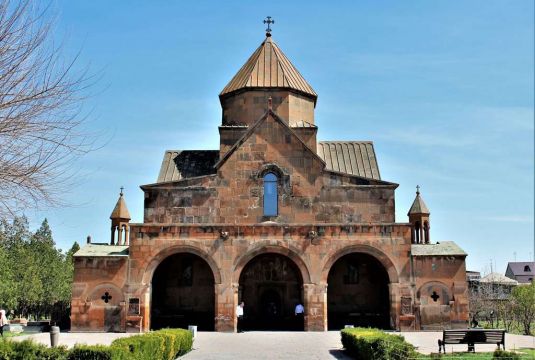
The St. Gayane monastery was built in 630, during the reign of the Catholicos Ezr I of Parazhnakert, on the chapel-testament of the matriarch Gayane, which was founded in 301, by St. Gregory the Illuminator, and served as a mausoleum-prayer containing the remains of the martyred virgins.
During its history, the monastery has undergone some architectural changes. So far, it is not known what the temple looked like before 1653, the renovations undertaken by the Catholicos Philip I Aghbaketsi. The latter, after a series of construction works, also orders to repair the chapel below the Senior Altar and the Holy Altar.
After about twenty-five years, the monastery is being renovated again, this time by Catholicos Yeghiazar I of Aintap. The top of the dome, partly the drum, was also changed. On the western side of the monastery, in 1688 a spacious and beautiful three-arched vestibule was built, it was fenced, monastic cells and a farm house were built. Catholicos Hakob V Shamakhets renovated the vestibule of the monastery. During the reign of Simeon Yerevantsi, in 1764, an underground building called "magatsa" was built on the western side of the temple, which served as a cellar-freezer.
The next significant renovation was done already during the reign of Catholicos Gevorg IV of Constantinople, when Archimandrite Vahan Bastamyants was appointed Abbot. During the reign of Hayrik Khrimyan, the roof and floor of the monastery were repaired. During the period of Patriarch Vazgen I, the renovations continued. Partial renovation works of the monastery were also carried out during the reign of Karekin II, Catholicos of All Armenians, in 2004.
The monastery was a prominent religious and scientific center in the Middle Ages. Despite Persian, Arab, Mongolian and Turkish invasions, as well as political, economic and social devastation, it has remained one of the centers of culture and spiritual thought. In 2000 it was included in the list of world cultural values of UNESCO.