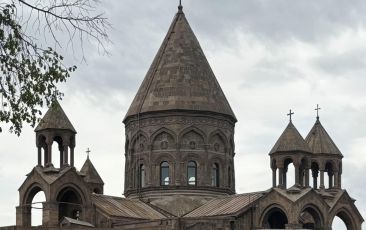
Meeting of the Supreme Spiritual Council at the Mother See of Holy Etchmiadzin
 13.03.2026
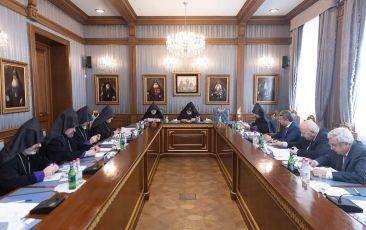
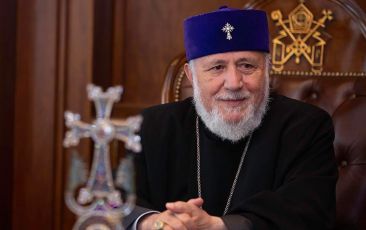
From March 10 to 13, a meeting of the Supreme Spiritual Council was held at the Mother See of Holy Etchmiadzin under the presidency of His Holiness Karekin II, Supreme Patriarch and Catholicos of All Armenians.
Following the greeting and blessing of the Catholicos of All Armenians, His Eminence Archbishop Nathan Hovhannisian, Chairman of the Monastic Council, was invited to preside over the sessions.
A report on the assembly of bishops held on February 17–19, 2026, in the city of St. Pölten, Austria, was presented by His Grace Bishop Armash Nalbandian, Primate of the Armenian Diocese of Damascus.
The Supreme Spiritual Council noted with satisfaction that the bishops participating in the gathering, in prayerful unity, discussed the challenges facing the Armenian Church, the current state of Church–State relations, as well as issues related to the effective fulfillment of the Church’s mission.
Several proposals were formulated to organize church life and address existing challenges. The Council resolved to make the necessary efforts to advance the resolution of these matters, emphasizing that issues arising within church life must be addressed exclusively through lawful and canonical means.
Information on the situation that arose in the Masyatsotn Diocese following the dismissal of its Primate was presented by the Locum Tenens of the diocese, Archimandrite Ruben Zargaryan. It was noted that the defrocked Arman Saroyan, with the unlawful support of state authorities, has been obstructing the diocesan pastoral, canonical, and administrative activities, thereby creating tension among the clergy and the faithful.
At the same time, it was emphasized that the majority of the diocesan clergy continue their pastoral ministry, remaining faithful to the Church's rules and canons.
Within the context of Church–State relations, reports on legislative initiatives, as well as on the progress of criminal, administrative, and civil proceedings initiated against the Mother See of Holy Etchmiadzin and against clergymen who have been unlawfully deprived of their liberty or subjected to other preventive measures, along with information on judicial decisions and related statistics, were presented by Doctor of Law Gevorg Danielyan and attorney, Candidate of Legal Sciences Ara Zohrabyan.
Emphasizing the imperative of respecting and protecting the rights and autonomy of the Church, as well as the principles of justice and democracy, the Supreme Spiritual Council condemned the arbitrary and discriminatory actions of the authorities of the Republic of Armenia, the persecution of the Armenian Church and its clergy, the imprisonment of clergymen on fabricated charges, as well as attempts—through the use of state mechanisms—to create artificial obstacles to the Church’s activities, restrict its functioning, and unlawfully interfere in church life.
The Council also considered legislative bills and subordinate acts recently introduced by the authorities that limit the legal status and activities of the Armenian Apostolic Holy Church. Their discussion, it was noted, is being used as a convenient pretext for advancing and freely disseminating anti-church rhetoric. It was further noted that such initiatives undermine the constitutional foundations of Church–State relations, particularly the right to freedom of conscience and religion.
The Supreme Spiritual Council also deemed unacceptable the accusatory and unfounded allegations directed at the Armenian Church and its clergy in the address delivered by Prime Minister Nikol Pashinyan at the European Parliament on March 11, 2026, including such characterizations as “agent of foreign influence,” “party of war,” and others.
According to the Council, such statements are clearly intended to justify the unlawful actions already undertaken by the authorities of the Republic of Armenia against the Church, as well as further repressive measures that may be planned.
A report on the convocation of the Church–Representative Assembly scheduled for September 2026, its agenda, and the formation of an organizing committee was presented by His Grace Bishop Mushegh Babayan, Director of the Administrative and Economic Department of the Mother See of Holy Etchmiadzin.
His Grace presented the participants with an overview of the preparatory work undertaken, as well as issues and proposals related to the organization of the Assembly. Appropriate instructions were issued in this regard.
Archimandrite Movses Sargsyan reported on the termination of pastoral service within the Armed Forces of the Republic of Armenia, the pressure exerted on military chaplains (regimental priests), and the resulting challenges.
The Supreme Spiritual Council affirmed that the unilateral decision of the Minister of Defense contradicts the provisions of the Constitution of the Republic of Armenia, the Law “On the Relations between the Republic of Armenia and the Armenian Apostolic Holy Church,” as well as the relevant governmental decision that stipulates the service of clergy within the Armed Forces.
Emphasizing the importance of military chaplains' ministry in strengthening the spiritual, moral, and psychological climate within the armed forces, the Council stressed the need to consider new arrangements for regulating this service and to identify ways to restore it within the legal framework.
A report on the academic and spiritual life in the spiritual and educational institutions of the Mother See of Holy Etchmiadzin was delivered by Hieromonk Husik Smbatyan, Dean of the Gevorgian Theological Seminary.
The participants of the meeting listened to the report with appreciation.
Emphasizing the importance of efforts to improve the training of clergy and develop theological education, the participants instructed that further consistent steps be taken to enhance educational programs and attract new students.
During the meeting, reports were also presented on the activities of the Mother See of Holy Etchmiadzin for 2025, the annual financial report, the final report on the completion of the construction of the Mother Cathedral, and the report of the Audit Commission. In addition, spiritual, educational, cultural, and social programs implemented in 2025 in Armenia and within Armenian diaspora communities were presented.